
Building a website means first structuring your offering: the power of merchandising
Merchandising is not about tidying up. It is a mental structure, a customer grammar, and a brand statement.
E-commerce merchandising is not about tidying up. It is a grammar.
Before product sheets, filters, reminders, SEO or acquisition campaigns, there is one fundamental thing: the way you structure your offer.
Why? Because it is this architecture that guides the customer, shows them that you have thought about them, and allows them to understand your universe, your promise, and the depth of your range.
Good merchandising is what makes it possible to find things. To understand. To move naturally towards a purchase, because we feel reassured. Because we feel at home.
It’s a conscious choice that allows us to speak to our audience and embody our positioning. It tells our personas: this is who we are. This is true when we walk into a physical shop – we know immediately whether we are entering a premium or discount environment. And it’s just as true online.
Take Decathlon: the architecture of the site, with its categories designed for all levels of practice, perfectly reflects its promise to make sport accessible to all. Merchandising becomes an act of alignment between brand, values and customer journey.
And ultimately, that’s what it’s all about: creating a logical, reassuring and meaningful journey that reflects both your brand and your customers’ expectations.
Why merchandising is often underestimated
In e-commerce, we often talk about product listings, SEO, average basket size and logistics. But we talk less about digital merchandising in terms of its structural dimension. And yet, if it can’t be found, it won’t sell.
Good merchandising isn’t just about “tidying up” products. It’s about:
- Think of categories as coherent (and complete) sets;
- Think of subcategories as logical subsets that allow users to navigate, refine their search, and filter effortlessly;
- Ensure that each level of reading is clear, comprehensive, and reassuring.
In other words, merchandising is more than just a menu; it is a mental framework that should guide customers as they browse and make their choices.
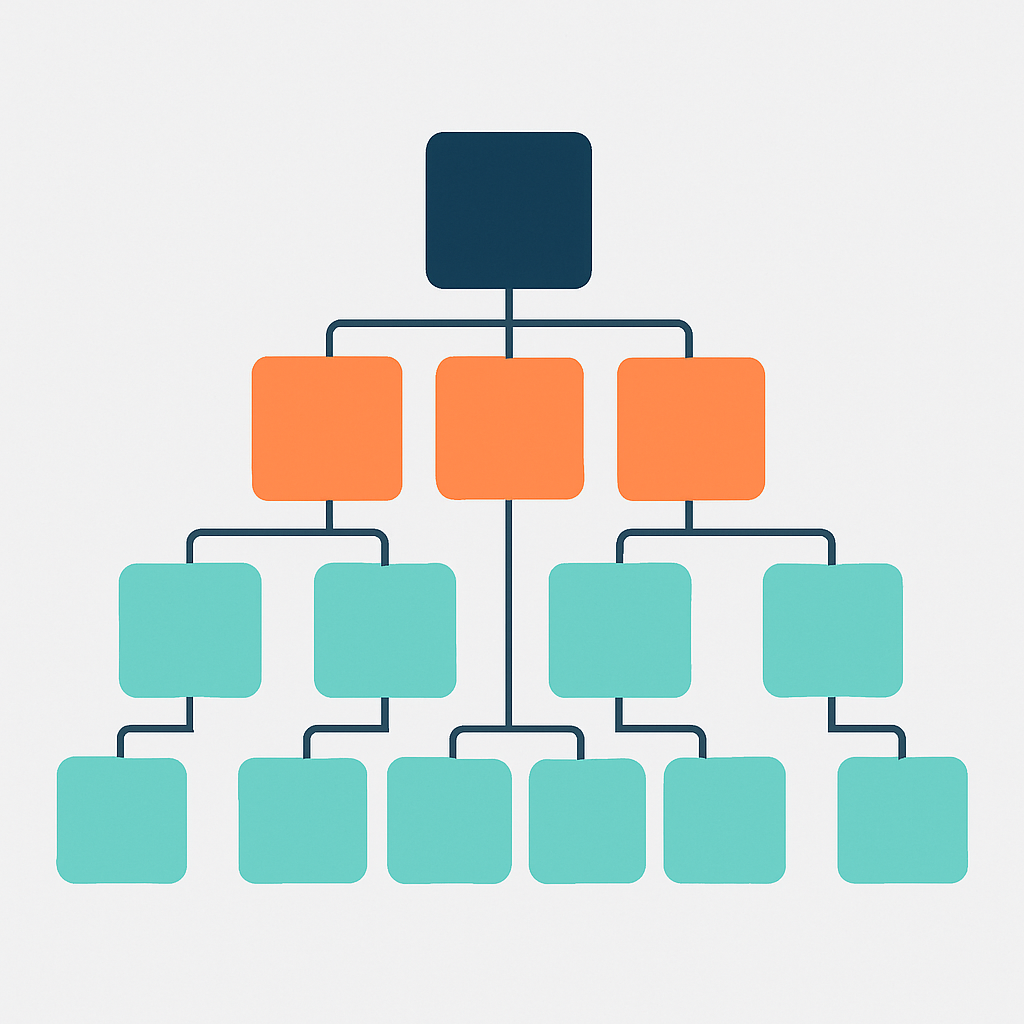
Merchandising as a law of sets
Let us imagine that your catalogue is a large set. Within it, you will create categories (sets), which contain subcategories (subsets), which themselves contain products.
This structure cannot be inconsistent: a subcategory must necessarily inherit the characteristics of the whole on which it depends. Otherwise, confusion ensues.
Example :
- Category: Sports shoes
- Subcategories: Trail shoes, Running shoes, Fitness shoes
- ❌ Bad example: placing city shoes in one of these subcategories
This mathematical logic has a fundamental virtue: it makes navigation intuitive. The customer progresses through logical steps, from the global universe to the specific choice.

Sub-sets that speak to the right personas
The big pitfall is wanting to create categories that are ‘logical for the business’ (e.g. by season, by internal collection, by product code, etc.) instead of building a logical tree structure for the customer.
This is where the persona comes into play.
You need to build your sets and subsets with usage and expectations in mind:
- By skill level (beginner / intermediate / expert)
- By specific need (work / travel / stay warm)
- By perceived value (good deal / exclusivity / ethics)
- By identified segment (men / women / children / professionals)
This is not a universal truth:
- A geek will prefer to filter by processor, RAM, frequency.
- A novice will prefer to filter by use: ‘teleworking’, “gaming”, ‘office automation’.
The best practice? Speak your customer’s language. No more, no less.
The importance of mental completeness
Good merchandising is not just about showcasing products. It aims to give the impression that the entire range is right there, available, accessible and well organised.
Decathlon is a typical example of this:
- Category: Trail running
- Sous-catégories : Débutant, Confirmé, Expert
Even though 80% of sales are to beginners, the other two categories are necessary:
- To guide users’ choices;
- To reassure them about the depth of the range;
- To provide clarity.
A rarely used category may be essential to enhance perceived completeness.

Filters and badges: dynamic subsets
In addition to the menu, filters allow users to create their own subsets. But be careful: each filter is a promise of relevant segmentation.
There are two approaches here:
- Technical filters: RAM, screen size, weight, material, etc.
- Usage filters: for remote working, for babies, for travel, etc.
The key point: adapt the language of the filters to the customer’s profile.
Similarly, badges play a visual merchandising role:
- “Made in France,” “Eco-designed,” “New,” “Best-seller,” “Private sale”…
Each badge targets a specific customer profile:
- A ‘Promo’ badge appeals to bargain hunters;
- An ‘Eco-friendly’ badge appeals to socially conscious customers;
- An ‘Online exclusive’ badge appeals to curious customers or those who love new products;
- A ‘Top-rated product’ badge reassures indecisive customers.
Once again, speaking the customer’s language is key.
✅ Does your tree structure follow a logical order of whole → subset → sub-subset?
✅ Is each category level clear, distinct, and without overlap?
✅ Are your filters suited to your personas (technical vs. usage)?
✅ Do your badges and highlights convey the right messages to the right target audience?
✅ Does your structure give the impression of being comprehensive, even in small subsets?
Merchandising as a driver of customer loyalty
It is often thought that merchandising is used to convert. That is true. But it is also used to build loyalty:
- A customer who easily finds what they are looking for will return.
- A customer who understands the full scope of the offer will return.
- A customer who feels recognised within the structure of the website will return.
In short, good merchandising appeals to the customer’s intuition. It reduces mental load. It streamlines the experience. It guides, directs and reassures.
In conclusion
Merchandising is not a minor task. It is the nervous system of your shop. It is what connects your products, your personas and your objectives.
Want to sell more? Improve your structure.
Want to build customer loyalty? Be clearer.
Want to go further? Ask your customers how they search for products and rebuild from there.
Because well-organised products sell better.